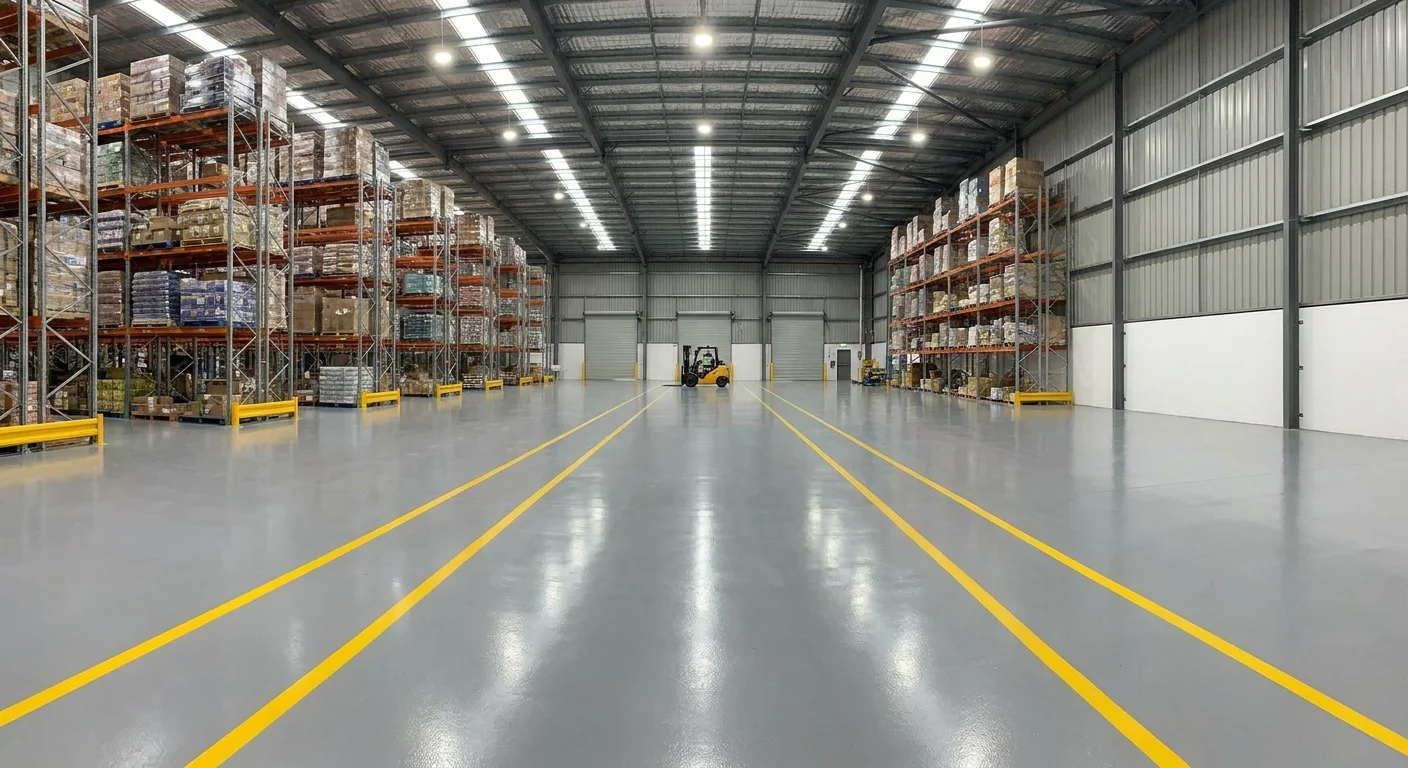
Engineered to handle forklifts, chemicals and the daily grind of industrial operations
Warehouse and industrial floors face the most punishing conditions in commercial flooring. Forklift traffic, heavy pallet loads, chemical spills, thermal cycling, impact damage and abrasive wear combine to destroy surfaces that were not specifically engineered for industrial use.
A failed warehouse floor is not just a maintenance problem — it is an operational risk. Crumbling concrete creates dust that contaminates stock. Deteriorating surfaces generate trip hazards. Damaged floors slow forklift operations, damage racking and create compliance issues with workplace health and safety regulations.
Suelo Flooring installs industrial flooring systems for warehouses, distribution centres, manufacturing facilities and cold storage operations across Southeast Queensland. We specify, prepare and apply coating systems that are engineered for the specific loads, chemicals and conditions your facility produces.
Industrial flooring systems
Epoxy flooring
Epoxy flooring systems are the workhorse of industrial flooring. A properly specified and installed epoxy system bonds to the concrete substrate to create a seamless, monolithic surface that resists chemical attack, impact damage and abrasive wear.
Epoxy systems for warehouses typically range from 2mm to 6mm in total thickness, depending on the anticipated loads, chemical exposure and performance requirements. Multi-coat systems with primer, body coat and topcoat deliver the best combination of adhesion, chemical resistance and surface performance.
Key properties of epoxy warehouse floors:
- Chemical resistance — Resistant to oils, fuels, cleaning agents, mild acids and alkalis common in warehouse operations
- Impact resistance — Withstands dropped tools, pallet impacts and point loads from racking
- Abrasion resistance — Handles forklift tyre wear, pallet dragging and daily foot traffic
- Seamless surface — No joints for contaminants to harbour; easy to sweep, scrub and maintain
- Dust-proof — Seals the concrete substrate, eliminating the concrete dust that untreated slabs generate
Polyurethane resin systems
For facilities where chemical exposure is more aggressive — food manufacturing, pharmaceutical storage, chemical handling — polyurethane resin systems offer enhanced chemical resistance, better UV stability and superior flexibility compared to standard epoxy. These systems cost more but deliver longer service life under aggressive chemical exposure.
Polyurethane cement (PU cement)
PU cement systems combine the chemical resistance of polyurethane with exceptional thermal shock resistance. They are the standard choice for cold storage facilities, blast freezer entries and food manufacturing plants where floors are exposed to rapid temperature changes, steam cleaning and aggressive chemical wash-downs.
Concrete preparation — the foundation of every industrial floor
No industrial coating system can outperform a poorly prepared substrate. Floor preparation in warehouse environments typically involves:
Concrete assessment — We test for moisture content, surface strength, contamination, flatness and structural integrity. Existing coatings, sealers or curing compounds must be identified and addressed.
Mechanical profiling — Diamond grinding or shot blasting creates the surface profile needed for coating adhesion. Different systems require different profiles — typically CSP 3 to CSP 5 for industrial epoxy and polyurethane systems.
Crack and joint repair — Structural and shrinkage cracks are routed and filled with flexible or rigid fillers depending on the crack type and anticipated movement. Joint edges are repaired to prevent coating failure at these stress points.
Levelling and patching — Localised damage, spalling and low spots are repaired with appropriate repair mortars to create a sound, level substrate.
Line marking and safety zones
Industrial flooring projects frequently include safety line marking as part of the scope. We install:
- Forklift traffic lanes — Defined vehicle pathways to separate pedestrian and forklift zones
- Pedestrian walkways — Clearly marked safe walking routes through operational areas
- Storage zones — Designated areas for pallet racking, staging and loading
- Hazard warnings — Yellow and red zone markings at intersections, loading docks and equipment zones
- Emergency exits — Pathway marking to exits in compliance with WHS requirements
Line marking is applied as part of the coating system, not as surface-applied paint. This ensures the markings share the same durability, chemical resistance and adhesion as the floor itself.
Cold storage considerations
Cold storage and freezer facilities present additional challenges for industrial flooring:
- Thermal shock — Floors at loading dock entries experience rapid temperature changes as doors open and close. Standard epoxy systems can crack under thermal cycling; PU cement systems handle this stress.
- Moisture condensation — Temperature differentials cause condensation on floor surfaces, creating slip hazards. Slip-resistant textures and appropriate drainage are critical.
- Substrate moisture — Cold storage slabs often have moisture vapour emission challenges that must be addressed before coating application.
- Anti-slip requirements — Wet, cold surfaces amplify slip risk. Products must maintain slip resistance ratings under these conditions.
Logan and Ipswich industrial estates
The Logan corridor contains one of Southeast Queensland’s largest concentrations of industrial and logistics facilities. Meadowbrook, Berrinba, Loganholme and the Logan Motorway corridor support major distribution centres, manufacturing plants and cold storage operations.
The Ipswich region — particularly Bundamba, Redbank Plains and the emerging Ebenezer industrial precinct — is experiencing rapid growth in warehouse and logistics development as the western corridor expands.
Both regions feature a mix of older facilities requiring floor remediation and new builds requiring first-time coating systems. We service industrial projects across both corridors, as well as the Brisbane Southside industrial zones around Rocklea, Salisbury and Acacia Ridge, and emerging logistics developments in the Northern Gold Coast around Yatala and Ormeau.
Recommended systems by industrial application
| Application | Recommended system | Key properties |
|---|---|---|
| General warehousing | Epoxy (3-4mm) | Chemical resistant, forklift rated, dust-proof |
| Distribution centres | Epoxy (4-6mm) | Heavy traffic, impact resistant, line marking |
| Manufacturing | Polyurethane resin | Enhanced chemical resistance, UV stable |
| Cold storage | PU cement | Thermal shock resistant, slip resistant |
| Loading docks | Epoxy with anti-slip | Impact resistant, weatherproof transition |
| Food manufacturing | Polyurethane resin | Food safe, thermal shock resistant, seamless |
Get an industrial flooring assessment
Every warehouse floor starts with a substrate assessment. We inspect, test and report on your existing slab condition before recommending a system. Request a quote or call us on 0426 409 499.
Back to commercial flooring | Back to all industry sectors.