Luxury Vinyl Plank vs Carpet Tile: Which Is Right for Your Commercial Space?
Key Takeaways
- Luxury vinyl plank wins on water resistance, durability and ease of cleaning. Carpet tile wins on acoustics, comfort and warmth.
- LVP costs slightly more to install but lasts longer, often making it cheaper over a full lifecycle.
- Most modern offices benefit from a combination of both, using each where it performs best.
- The subfloor condition and moisture levels should influence your choice as much as aesthetics.
Introduction
Walk into any commercial fit-out discussion in 2026, and two products dominate the conversation: luxury vinyl plank and carpet tile. Between them, they cover roughly 70 per cent of all new commercial flooring installations in Australia.
Both are excellent products. Both come in a vast range of designs. And both are marketed aggressively, which makes it hard to cut through the noise and figure out which one actually suits your space.
This comparison lays out the facts. No spin, no agenda. Just a clear side-by-side assessment to help you choose the right commercial flooring for your business.
Head-to-Head Comparison
| Factor | Luxury Vinyl Plank | Carpet Tile |
|---|---|---|
| Water resistance | Fully waterproof | Not waterproof |
| Acoustic performance | Moderate (with underlay) | Excellent |
| Durability | 15 - 25 years commercial | 8 - 15 years commercial |
| Installed cost (per sqm) | $55 - $110 | $45 - $90 |
| Maintenance | Sweep and mop | Vacuum and periodic deep clean |
| Comfort underfoot | Firm | Soft |
| Slip resistance | Good (varies by texture) | Excellent |
| Replacement | Individual planks replaceable | Individual tiles replaceable |
| Design range | Timber, stone, concrete looks | Solid, pattern, plank styles |
| Environmental impact | Recyclable (varies by brand) | Recyclable (varies by brand) |
Where Luxury Vinyl Plank Excels
Water and Spill Resistance
LVP is waterproof. Full stop. Spills, wet mopping, tracked-in rain — none of it causes damage. This makes luxury vinyl plank the default choice for any space where moisture is a factor.
Reception areas, kitchens, bathrooms, retail spaces near entrances, hospitality venues — anywhere drinks, food, or weather might meet the floor.
Durability Under Heavy Traffic
Commercial-grade LVP uses a rigid core (typically SPC or WPC) with a wear layer of 0.5mm or more. This construction handles trolleys, high heels, office chairs, and heavy foot traffic without denting or scratching.
The wear layer rating matters. Look for products rated to AS/NZS 4561 for commercial use. A residential product in a commercial space will fail within two to three years.
Cleaning Simplicity
Sweep or vacuum. Damp mop. Done. No specialist cleaning equipment, no expensive cleaning products. For businesses where staff time and cleaning budgets are tight, this simplicity adds up to real savings.
Design Versatility
Modern LVP convincingly replicates timber, stone, concrete, and terrazzo. The printing and texturing technology has advanced to the point where many people cannot tell the difference from real timber at floor level.
This means you can achieve a high-end timber or stone look at a fraction of the cost, with none of the maintenance headaches.
Where Carpet Tile Excels
Acoustic Performance
This is carpet tile’s superpower. In open-plan offices, call centres, and any space where noise management matters, carpet tile outperforms every hard flooring product.
Carpet tile absorbs sound energy instead of reflecting it. The result is lower ambient noise, better speech privacy, and a calmer working environment. Some premium carpet tiles achieve noise reduction coefficients (NRC) above 0.30, compared to around 0.05 for hard flooring.
If you have ever worked in an open-plan office with hard floors and no soft furnishings, you know how unpleasant the noise can be. Carpet tile solves that problem at the floor level.
Comfort and Warmth
Carpet tile is warmer underfoot and softer on joints. Staff who stand or walk for long periods notice the difference. In winter, carpet tile retains warmth better than any hard surface.
For workplaces focused on employee wellbeing, this matters more than most people realise.
Slip Resistance
Carpet tile offers inherently high slip resistance, even when wet. This makes it a strong choice for corridors, ramps, and any area where slip risk is a concern.
Design Flexibility
Modern carpet tile has moved far beyond the beige grid squares of the 1990s. Plank-format carpet tiles, geometric patterns, colour blocking, and custom designs allow architects and designers to create genuinely striking commercial interiors.
Individual tiles can be rotated, mixed, and combined to create unique layouts. Damaged or stained tiles can be swapped out without replacing the entire floor.
The Case for Using Both
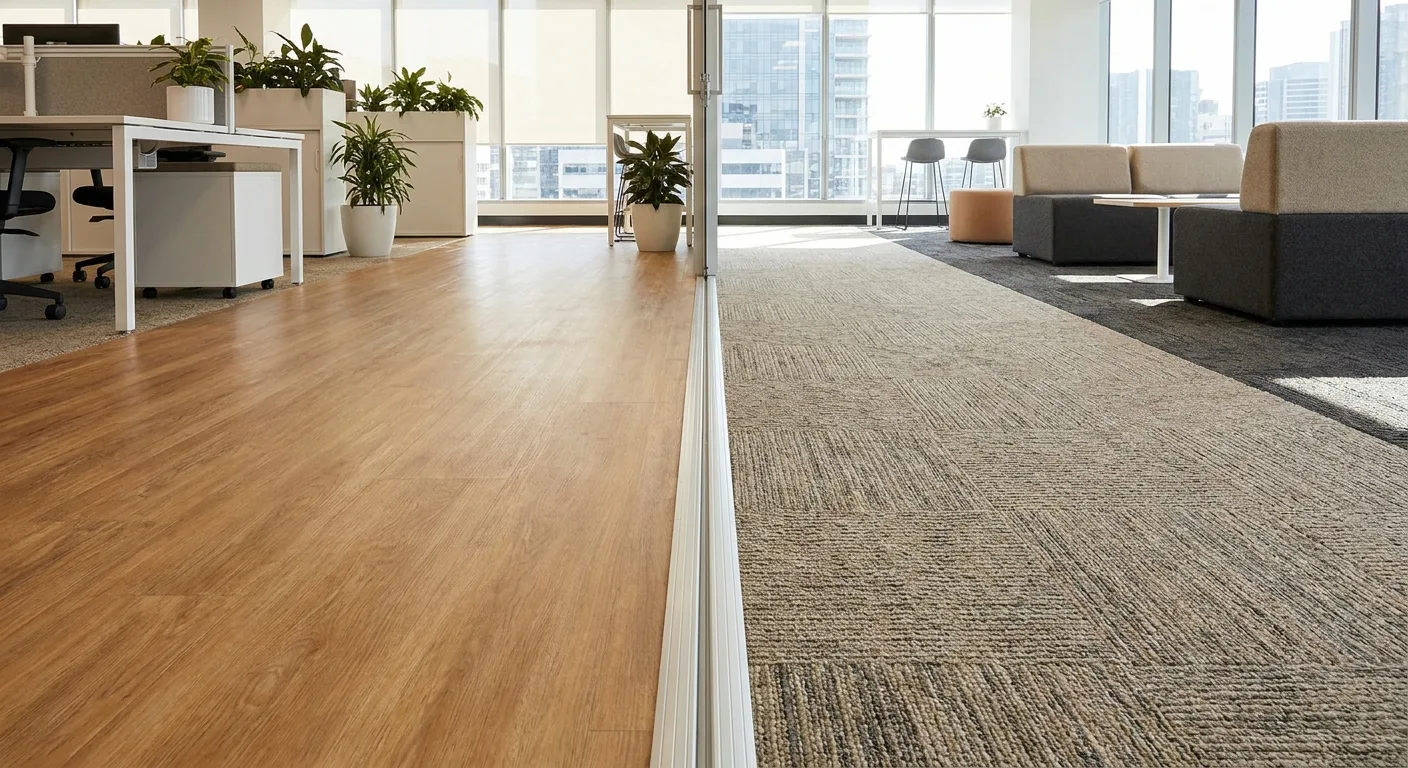
In most commercial spaces, the smartest approach is not choosing one or the other. It is using both in the areas where each performs best.
A typical office fit-out might use:
- LVP in: Reception, kitchenette, bathroom areas, walkways near entrances
- Carpet tile in: Open-plan work areas, meeting rooms, executive offices, breakout spaces
This approach gives you waterproofing where you need it, acoustic control where you need it, and visual variety that defines different zones within your space.
The transition between the two products is handled with aluminium or PVC trim strips that sit flush with both surfaces. When planned from the start, these transitions look clean and intentional.
Cost Comparison: Beyond the Price Tag
The installed cost per square metre only tells part of the story. A full lifecycle cost comparison includes maintenance, replacement, and downtime.
Ten-Year Cost Scenario (500 sqm Office)
| Cost Factor | LVP | Carpet Tile |
|---|---|---|
| Supply and install | $40,000 | $33,000 |
| Annual maintenance | $800 | $2,500 |
| Replacement tiles/planks | $500 | $1,500 |
| Deep cleaning (annual) | $0 | $2,000 |
| Ten-year total | $53,000 | $73,000 |
These are indicative figures for a medium-traffic Brisbane office. Your actual costs will vary based on product selection, traffic levels, and maintenance standards.
The upfront cost advantage of carpet tile often reverses when you factor in the higher ongoing maintenance and shorter lifespan. LVP’s lower maintenance demands and longer service life make it the more economical choice in many scenarios.
That said, if acoustic performance is your primary concern, the additional cost of carpet tile is an investment in workplace productivity and staff comfort. Those benefits are harder to quantify but very real.
Climate Considerations for Southeast Queensland
Brisbane’s subtropical climate influences this decision in ways that do not apply in Melbourne or Sydney.
Humidity: High ambient humidity can affect carpet tile if moisture migrates through the slab. A moisture barrier or DPM (damp-proof membrane) is essential for carpet tile on ground-floor slabs in Queensland. LVP is less sensitive to slab moisture but still requires testing.
Temperature: Carpet tile stays cooler in air-conditioned spaces because it does not conduct heat as readily as hard flooring. In spaces without air conditioning, LVP can feel warm underfoot on hot days.
Flooding risk: If your premises are in a flood-prone area, LVP is the safer choice. It can be dried, cleaned, and reused after minor flooding. Carpet tile typically needs full replacement after water damage.
Professional floor preparation and moisture testing are essential regardless of which product you choose. The subfloor condition determines the success of the installation more than any other factor.
How to Make Your Decision
Ask these five questions:
- Is moisture a factor in your space? If yes, lean toward LVP in those areas.
- Is noise a problem or concern? If yes, lean toward carpet tile in those areas.
- What is your maintenance capacity? Limited cleaning resources favour LVP.
- What is your budget horizon? Tight upfront budget favours carpet tile. Lifecycle budget favours LVP.
- What look and feel do you want? Visit a showroom and stand on both products. Your instinct matters.
Conclusion
Luxury vinyl plank and carpet tile are both proven, reliable commercial flooring products. The question is not which is better overall. It is which is better for your specific space, traffic patterns, moisture exposure, acoustic needs, and budget.
In most cases, a combination of both delivers the best outcome. Use each product where its strengths matter most, and you get a floor that performs, looks good, and lasts.
Need help choosing between luxury vinyl plank and carpet tile? Suelo Flooring supplies and installs both across Southeast Queensland. Contact us for a free site assessment and samples delivered to your door.
Related Articles:
Suelo Flooring
Suelo Flooring delivers specialist commercial flooring across Southeast Queensland. An experienced, dedicated team manages every project from consultation to handover.
About Suelo Flooring